Why do rainforests have so many kinds of plants and animals?
Tropical rainforests support the greatest diversity of living organisms on Earth. Although they cover less than 2 percent of Earth’s surface, rainforests house more than 50 percent of all plants and animals found on land.
Here are some examples of the richness of rainforests:
- Rainforests have 170,000 of the world’s 250,000 known plant species. That’s more than two-thirds of all plants!
- The United States has 81 species of frogs, while Madagascar, which is smaller than Texas, may have 500 species.
- An area of rainforest the size of two football fields (one hectare) may have more than 400 species of trees, while an equal area of forest in the United States may have fewer than 20.
- Europe has 570 butterfly species, while Manu National Park, a single reserve in Peru, has 1,300 species.

Rainforests have an abundance of plants and animals for the following reasons:
- Climate: because rainforests are located in tropical regions, they receive a lot of sunlight. The sunlight is converted to energy by plants through the process of photosynthesis. Since there is a lot of sunlight, there is a lot of energy in the rainforest. This energy is stored in plant vegetation, which is eaten by animals. The abundance of energy supports an abundance of plant and animal species.
- The Canopy: the canopy structure of the rainforest provides an abundance of places for plants to grow and animals to live. The canopy offers sources of food, shelter, and hiding places, providing for interaction between different species. For example, there are plants in the canopy called bromeliads that store water in their leaves. Frogs and other animals use these pockets of water for hunting and laying their eggs.
It is important to note that many species in the rainforest, especially insects and fungi, have not even been discovered yet by scientists. Every year new species of mammals, birds (slideshow), frogs (slideshow), and reptiles (slideshow) are found in rainforests.
Special activity section: camouflage
Rainforest mammals
Tropical rainforests are home to many kinds of mammals, ranging in size from tiny mouse lemurs to the African forest elephant. While large mammals like cats (tigers, jaguars, leopards, and small cats) and primates (including monkeys, apes, and lemurs) are best known, most rainforest mammals are small, nocturnal, and inconspicuous. Bats and rodents are the most abundant kinds of mammals in most rainforests.
Rainforest birds
Tropical rainforests are home to many kinds of birds, including parrots, hornbills, toucans, and raptors like eagles, hawks, and vultures.
Some migratory birds live in rainforests during the winter and return to cooler regions during the spring and summer. For example, many songbirds that nest in the United States winter in Central America or even the Amazon.
Below you will find profiles for a few rainforest birds as well as a selection of photos. Please note there is more extensive information about rainforest birds, including specific species, at the main rainforest site.
Rainforest Reptiles & Amphibians
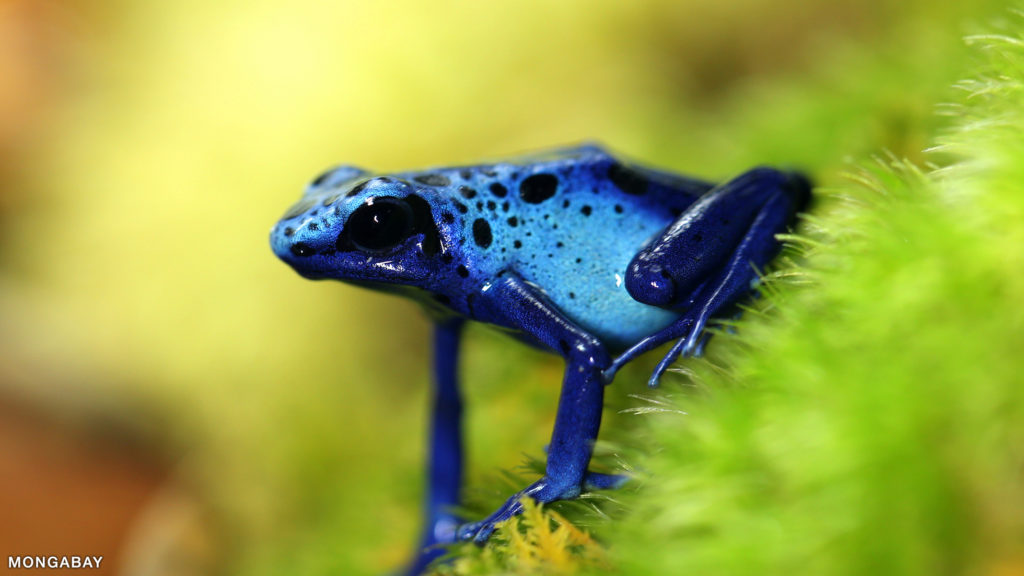
Tropical rainforests are home to a huge diversity of reptiles (snakes, lizards, turtles, tortoises, and crocodiles) and amphibians (frogs, toads, salamanders, newts, and worm-like caecilians). These are found in virtually all rainforest habitats, ranging from the high canopy to streams and creeks. Collectively, reptiles and amphibians are known as herps.
Many herps are threatened by habitat loss, the pet trade, and environmental change. Amphibians are particularly at risk from a deadly disease that is spreading around the globe. The disease has already caused the extinction of at least 170 species of frogs and toads over the past 30 years. Scientists have not yet pinpointed what is causing the outbreak or how it can be controlled. Emergency measures have been implemented for some endangered species, which are being collected and kept in zoos, aquariums, and botanical gardens until a cure can be found.
Below you will find profiles for a few rainforest herps as well as a selection of photos. Please note there is more extensive information about rainforest herps, including specific species, at the main rainforest site.
Rainforest fish
Tropical rainforest waters — including rivers, creeks, lakes, and swamps — are home to the majority of freshwater fish species. The Amazon Basin alone has over 3,000 known species and possibly as many unidentified species.
Many of the tropical fish kept in freshwater aquariums are originally from the rainforest. Fish like angelfish, neon tetras, discus, and common algae-eating catfish come from the tropical forests of South America, while danios, gouramis, Siamese fighting fish (or Betta), and the clown loach are from Asia.
Tropical freshwater fish are a major source of protein for many rainforest communities. Because of the importance of fish as a food source, in some places dams are a major threat to forest-dependent peoples. Dams can block fish migration and flood important fish habitat.
Rainforest insects
Most of the animal species found in the rainforest are invertebrates, including insects, arachnids (such as spiders and scorpions), and worms.
Amazingly, about one quarter of all animal species that have been named and described by scientists are beetles. More than 500,000 kinds of beetles are known to exist, many of them from the world’s rainforests.
Rainforest invertebrates come in an incredible array of sizes, ranging from organisms that can sit on a pinhead to the goliath beetle of Africa, which can weigh nearly a quarter of a pound (110 grams). Some Bornean stick insects—which are experts in disguise—can attain a length of more than 20 inches (50cm).
Below you will find some photos of rainforest insects. Please note there is more extensive information about rainforest insects, including specific species, at the main rainforest site.
Rainforest plants
The forest floor of old-growth rainforest is rarely the thick, tangled jungle seen in movies and adventure stories. It is usually relatively clear of dense vegetation due to the deep darkness created by the canopy. So instead of choking vegetation, a visitor to the rainforest will find large tree trunks interspersed with hanging vines, countless seedlings and saplings, and a relatively small number of ground plants.
Because rainforest trees are in a constant battle for access to sunlight, they grow straight and tall, only branching near the top of their long, pole-like trunks. Because of the intense sunlight in the tropics, many plants have adapted to living in the canopy. Some of the most common are epiphytes, which are plants that attach themselves to trees. In some forests epiphytes can be very abundant—over 2,000 epiphytes may be found on a single tree.
While the idea of a plant that lives on another plant may seem strange, many house plants are by nature epiphytes. Well-known examples include bromeliads or “air plants” and some kinds of orchids.
Rainforests have a huge variety of tree species. It is not unusual to find more than 200 different types of trees in a couple of acres of rainforest.
Diversity protects species. A species that becomes too abundant in natural forests faces the threat of a predator adapting to exploit its abundance. For example, in the Amazon the failure of rubber tree plantations, where only a single species is grown, is due to a fungus that feeds on the tree. In the natural rainforest, rubber trees are widely dispersed so the fungus can never wipe out more than one individual tree at a time. That’s why plantations and single-species agriculture are so susceptible to pests and require toxic chemicals.
Chapter review questions
- Why do rainforests have so many species?
- What are some examples of countries that have the most species of animals?
- What are examples of mammals that live in the rainforest?
- What kind of mammals are most abundant in the rainforest?
- What are some examples of birds that live in the rainforest?
- What is it called when animals move from one part of the world to another in response to seasons?
- What are some examples of reptiles?
- What are some examples of amphibians?
- Why are some reptiles and amphibians threatened?
- Why are rainforest rivers important for forest-dependent peoples?
- What are examples of freshwater fish from the rainforest?
- Why are dams a threat to rainforest fish?
- What are examples of invertebrates from the rainforest?
- What is the largest group of insects?
- What are some characteristics of rainforest trees?
- Why is diversity important for plants in the rainforest?
- What is an epiphyte?
Additional resources
- Rainforest biodiversity From our main rainforests web site
- The top 10 most biodiverse countries From Mongabay’s news site
- Biodiversity by country From our main rainforests web site
- Rainforest canopy animals From our main rainforests web site
- Mammals of the rainforest floor From our main rainforests web site
- Predators of the rainforest floor From our main rainforests web site
- Mammal biodiversity by country From our main rainforests web site
- Mammals news feed From Mongabay’s news site
- Canopy birds From our main rainforests web site
- Rainforest ground birds From our main rainforests web site
- Rainforest bird photos From our photo site
- Bird biodiversity by country From our main rainforests web site
- Birds news feed From Mongabay’s news site
- Reptiles and amphibians of the rainforest canopy From our main rainforests web site
- Reptiles of the rainforest floor From our main rainforests web site
- Rainforest herp photos From our photo site
- Amphibian biodiversity by country From our main rainforests web site
- Reptile biodiversity by country From our main rainforests web site
- Herps news feed From Mongabay’s news site
- Invertebrates in the rainforest canopy From our main rainforests web site
- Invertebrates of the rainforest floor From our main rainforests web site
- Rainforest invertebrate photos From our photo site
- Insects news feed From Mongabay’s news site
- The Great Insect Dying In 2019, Mongabay published a four-part miniseries which took a deep dive into the science behind the so-called “Insect Apocalypse.”
- Rainforest canopy trees From our main rainforests web site
- Epiphytes From our main rainforests web site
- Seeds and fruits of the rainforest From our main rainforests web site
- Plant biodiversity by country From our main rainforests web site