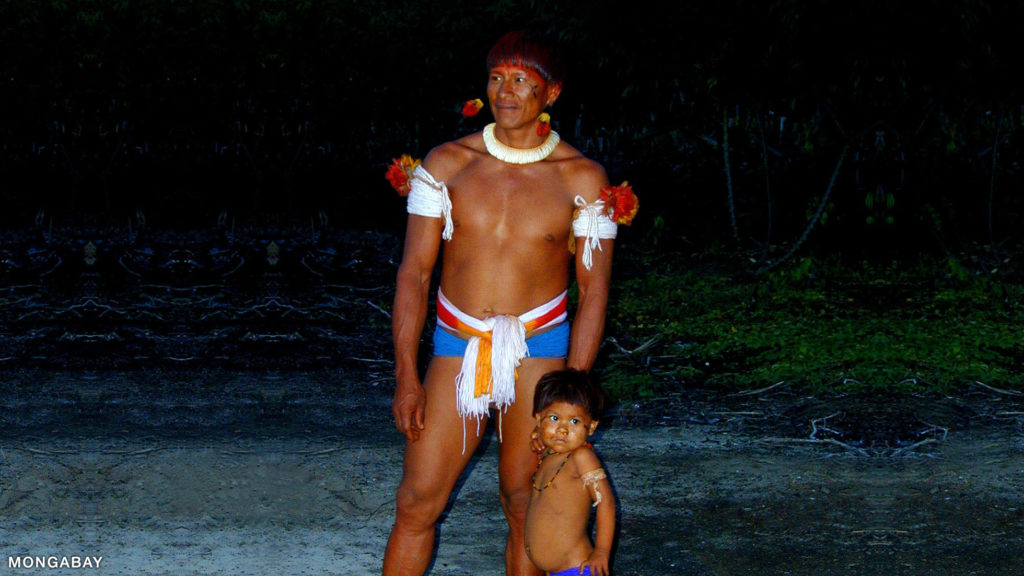
Tropical rainforests are home to indigenous peoples who rely on their surroundings for food, shelter, and medicines. Today very few forest people live in traditional ways; most have been displaced by outside settlers or have been forced to give up their lifestyles by governments.
Of the remaining forest people, the Amazon supports the largest native, or indigenous populations, although these people, too, have been impacted by the modern world. While they still depend on the forest for traditional hunting and gathering, most Amerindians, as American indigenous people are called, grow crops (like bananas, manioc, and rice), use western goods (like metal pots, pans, and utensils), and make regular trips to towns and cities to bring foods and wares to market. Still, these forest people can teach us a lot about the rainforest. Their knowledge of medicinal plants used for treating illness is unmatched, and they have a great understanding of the ecology of the Amazon rainforest.
In Africa there are native forest dwellers sometimes known as pygmies. The tallest of these people, also called the Mbuti, rarely exceed 5 feet in height. Their small size enables them to move about the forest more efficiently than taller people.
Great civilizations in the rainforest
Today most forest dwellers live in small settlements or practice nomadic hunting and gathering. In the past, tropical rainforests and surrounding areas supported great civilizations like the Mayas, Incas, and Aztecs that developed complex societies and made important contributions to science.
These great civilizations faced some of the same environmental problems (excessive forest loss, soil erosion, overpopulation, lack of water supplies) that we face today. For the Maya, the damage they caused to the environment apparently was great enough to cause their downfall.
Uncontacted tribes in the rainforest
Today very few Amerindians live in their fully traditional ways, although there remain dozens of “uncontacted” groups living in remote parts of Brazil, Peru, Colombia, Paraguay, the Andaman Islands off India, New Guinea, and possibly Ecuador and Bolivia. Uncontacted tribes, more commonly called indigenous peoples living in voluntary isolation, are generally small bands that have splintered off from groups that have contact with the outside world. Brazil accounts for the largest number of groups living in voluntary isolation.
In Brazil, Peru, and Colombia, these groups are granted substantial territories to enable them to continue living in isolation should they choose. However, conflict is still known arise between outside parities and these groups. In Brazil, invasion of lands belonging to uncontacted tribes is generally illegal — trespassers are usually cattle ranchers, loggers, miners or drug traffickers.


Indigenous peoples living in voluntary isolation are particularly vulnerable to outside disease since they haven’t been exposed to many of the viruses, bacteria, and other pathogens that we encounter on a regular basis.
Rainforest plant knowledge of native people
One of the most exciting areas of research in tropical forests is ethnobotany, which is the study of how people use plants to treat illness and disease. Forest people have an incredible knowledge of medicinal plants, with remedies for everything from snakebites to tumors.
To date, many of the prescription drugs used in the western world have been derived from plants. Seventy percent of the plants identified by the U.S. National Cancer Institute as having anti-cancer characteristics are found only in forests.
The shaman or “medicine man” of a village typically holds knowledge of medicinal plants. The shaman treats the sick, often during elaborate ceremonies and rituals using plants gathered from the surrounding forest.
Shamans have incredible healing powers, but their knowledge is rapidly disappearing as rainforests are cut down and tribes abandon their traditions. Shamans are going extinct faster than rare and endangered species.
What happened to the native people of the Amazon?
Before the beginning of European colonization of the New World in the 15th century, an estimated seven to ten million Amerindians lived in American rainforests, half of them in Brazil. Great cities existed in the Andes, while the Amazon supported agricultural societies.
The arrival of Europeans brought about the end of the native civilizations in Central and South America. Europeans carried diseases that killed millions of Amerindians, and within 100 years of the arrival of these outsiders, the Amerindian population was reduced by 90 percent. Most of the surviving native people lived in the interior of the forest, either pushed there by the Europeans, or living traditionally in smaller groups.
Kids in the Rainforest
Although they generally don’t watch TV, use the Internet, or play video games, kids in the rainforest do many of the same things you probably do. They play with friends, help their families with chores, and go to school.
Since “rainforest kids” live closer to nature than the average American child, they learn things that are helpful in the environment around them. From an early age many children learn how to fish, hunt, and collect materials and food from the forest. Instead of going to a playground or a shopping mall for fun, children in places like the Amazon spend most of their time outdoors playing in the forest and in rivers and streams.
Threats to rainforest people
There are several reasons the lives of forest peoples are changing. Tribes in places like the Amazon and Malaysia are losing their traditional land to governments and developers. The forests they have used for countless generations are being cut down by loggers, torn up by miners, and hunted by poachers. The rivers they use for water and fishing are being dammed to produce electricity for far-off cities. When forest people resist these developments, they may be ridiculed, arrested, forcibly moved, or even killed.
Rainforest people themselves are choosing to change the way they live. For the indigenous, the lure of urban culture is strong. Cities seem to offer the promise of affluence and the conveniences of an easy life. But in leaving their forest homes indigenous peoples usually meet with a stark reality: the skills that serve them so well in the forest don’t translate well to an urban setting. The odds are stacked against them; they arrive near the bottom of the social ladder, often not proficient in the language and customs of city dwellers. The lucky ones may find work in factories or as day laborers and security guards, but many eventually return to the countryside. Some re-integrate into their villages, others join the ranks of miners and loggers who trespass on indigenous lands, negotiating deals that pit members of the same tribe against each other in order to exploit the resources they steward. As tribes are fragmented and forests fall, indigenous culture—and its wealth of profound knowledge —is lost. The world is left a poorer place, culturally and biologically.
Chapter review questions
- Who lives in the rainforest?
- Where do the greatest number of indigenous rainforest peoples live today?
- What are examples of past great rainforest civilizations?
- Do “uncontacted peoples” still exist?
- What is ethnobotany?
- What’s another name for a traditional indigenous healer or ‘medicine man’?
- What’s happening to traditional indigenous knowledge?
- What happened to the indigenous population when Europeans colonized the Americas?
- How are the lives of indigenous rainforest children different from lives of Western children?
- What are some challenges faced by indigenous peoples in the 21st century?
Additional resources
- Rainforest peoples From our main rainforests web site
- Amazon peoples From our main rainforests web site
- Congo peoples From our main rainforests web site
- Indigenous peoples news feed From Mongabay News
- Ancient civilizations news feed From Mongabay News
- Uncontacted tribes news feed From Mongabay News
- Uncontacted tribes still exist, but extinction threat looms From Mongabay News
- Using Google Earth to protect uncontacted tribes in the Amazon rainforest From Mongabay News
- What we can learn from uncontacted rainforest tribes From Mongabay News
- Medicinal plants From our main rainforests web site
- Ethnobotany news feed From Mongabay News
- Medicinal plants news feed From Mongabay News
- Indigenous peoples news feed From Mongabay News
- Rainforest people news feed From Mongabay News