
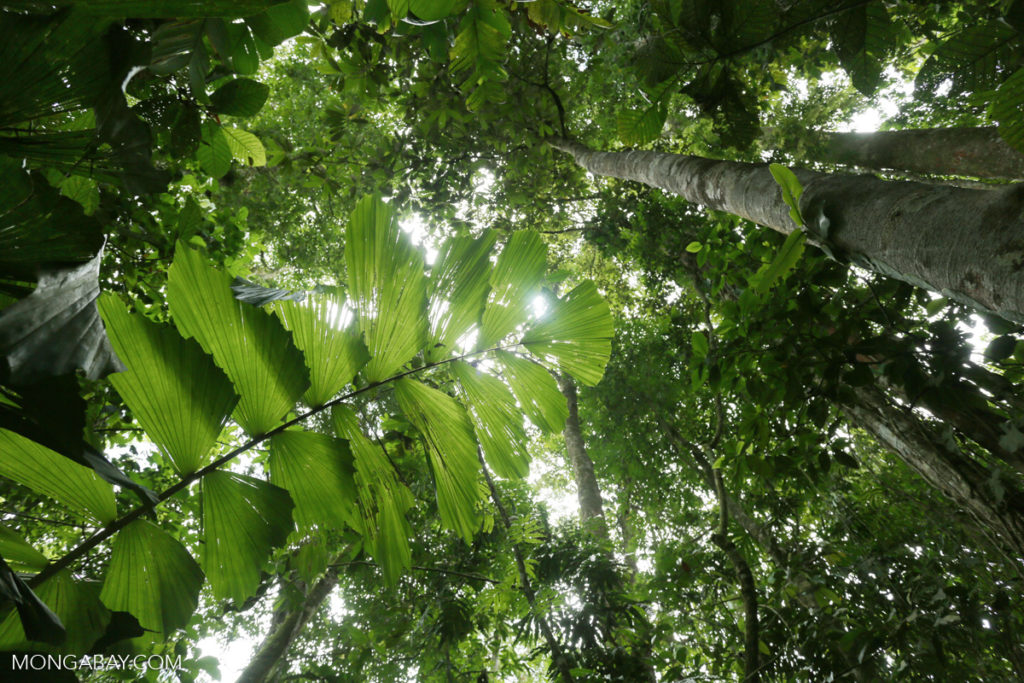
The first time I saw the Amazon river, I was awed by its size. It looked like an ocean, and for good reason.
During the high water season, the Amazon’s mouth may be 300 miles wide, and every day up to 17 billion metric tons of water flow into the Atlantic Ocean. For reference, the Amazon discharges enough fresh water daily into the Atlantic to supply New York City’s freshwater needs for nine years. The force of the current causes Amazon River water to continue flowing 125 miles out to sea before mixing with Atlantic salt water. Early sailors could drink fresh water out of the ocean before sighting the South American continent.
What is even more awesome about the Amazon is the rainforest that feeds it. Trees are water factories—they release or transpire water into the atmosphere. Across the entire Amazon, trees produce 20 billion tons of water per day, or the equivalent of more than one-fifth of all the fresh water that flows into Earth’s oceans!
Why are rainforests important?
Flying over the heart of the Amazon is like flying over an ocean of green: an expanse of trees broken only by rivers. Even more amazing than their size is the role the Amazon and other rainforests around the world play in our everyday lives.
While rainforests may seem like a distant concern, these ecosystems are critically important for our well-being.
Rainforests are often called the lungs of the planet for their role in absorbing carbon dioxide, a greenhouse gas, and producing oxygen, upon which all animals depend for survival. Rainforests also stabilize climate, house incredible amounts of plants and wildlife, and produce nourishing rainfall all around the planet.
Rainforests:
• help stabilize the world’s climate;
• provide a home to many plants and animals;
• maintain the water cycle;
• protect against flood, drought, and erosion;
• are a source for medicines and foods;
• support tribal people; and
• are an interesting place to visit.
Rainforests help stabilize climate
Rainforests help stabilize the world’s climate by absorbing carbon dioxide from the atmosphere. Scientists have shown that excess carbon dioxide in the atmosphere from human activities is contributing to climate change. Therefore, living rainforests have an important role in mitigating climate change, but when rainforests are chopped down and burned, the carbon stored in their wood and leaves is released into the atmosphere, contributing to climate change.
Rainforests also affect local weather conditions by creating rainfall and moderating temperatures.
Rainforests provide a home for plants and wildlife
Rainforests are home to a large number of the world’s plant and animals species, including many endangered species. As forests are cut down, many species are doomed to extinction.
Most rainforest species can survive only in their natural habitat. As their habitat is destroyed, many well-known rainforest species are threatened with extinction, including orangutans, rhinos, tigers, gorillas, elephants, as well as many birds, monkeys, reptiles, and amphibians.
Zoos cannot save all animals.
Rainforests help maintain the water cycle
The role of rainforests in the water cycle is to add water to the atmosphere through the process of transpiration (in which plants release water from their leaves during photosynthesis). This moisture contributes to the formation of rain clouds, which release the water back onto the rainforest. In the Amazon, 50-80 percent of moisture remains in the ecosystem’s water cycle.
When forests are cut down, less moisture goes into the atmosphere and rainfall declines, sometimes leading to drought.
In recent years, the rainforests of Borneo and the Amazon have experienced very severe droughts. These have been made worse by deforestation.
Moisture generated by rainforests travels around the world. Scientists have discovered that rainfall in America’s Midwest is affected by forests in the Congo. Meanwhile, moisture created in the Amazon ends up falling as rain as far away as Texas, and forests in Southeast Asia influence rain patterns in southeastern Europe and China. Distant rainforests are therefore important to farmers everywhere.
Rainforests reduce erosion
The roots of rainforest trees and vegetation help anchor the soil. When trees are cut down there is no longer anything to protect the ground, and soils are quickly washed away with rain. The process of washing away of soil is known as erosion.
As soil is washed down into rivers it causes problems for fish and people. Fish suffer because water becomes clouded and spawning grounds fill with silt, while people have trouble navigating waterways that are shallower because of the increased amount of dirt in the water. Meanwhile, farmers lose topsoil that is needed for growing crops, and dams generate less electricity.
On steep hillsides, loss of forest can trigger landslides. For example, thousands of people were killed in Central America during Hurricane Mitch of 1998 when deforested hillsides collapsed. Had forests been maintained, the death toll would have been lower.
Forests also play an important role in reducing damage from flooding by reducing the rate of water runoff.
During the devastating 2004 Indian Ocean tsunami, areas where mangrove forests had been cut down suffered more devastation than areas where healthy mangrove forests remained as a buffer. Mangroves also help protect against coastal erosion.
Rainforests provide resources for people
People have long used forests as a source of food, wood, medicine, and recreation. When forests are lost, they can no longer provide these resources. Instead people must find other places to get these goods and services. They also must find ways to pay for the things they once got for free from the forest.
As a frequent visitor to rainforests, I can attest that they provide much more than life-saving medicines and nourishing fruit. Rainforests are found in a variety of landscapes: some are situated on scenic mountain ranges, others hug giant lowland rivers, while more still are found near beautiful beaches and coral reefs. Rainforests offer opportunities for cultural exchange, photography, adventure, fishing, hiking, relaxation, birding and wildlife spotting.